
How to Get Your Local Business Recommended by ChatGPT and AI Search in 2026
If you want ChatGPT, Google’s AI experiences, Perplexity or other AI-powered search tools to recommend your local business, the answer is not to publish more AI-generated blogs or stuff your website with keywords. It starts with something much more fundamental: your business needs to be easy to discover, easy to verify and consistent everywhere it appears online.
For a local business, AI visibility depends heavily on the wider digital footprint around the company. Your website matters, but so do your Google Business Profile, reviews, local directories, social profiles, citations, customer discussions, relevant community mentions and the consistency of your business information across all of those sources.
ChatGPT Search now uses live web information and can provide location-based recommendations. OpenAI also states that search results are ranked using multiple signals intended to surface relevant and reliable information, although no business can guarantee top placement.
That changes the way businesses should think about SEO. Ranking on Google still matters, but increasingly the goal is to create an online presence that search engines and AI systems can confidently understand and verify.
NAP Consistency Comes Before AI Optimization
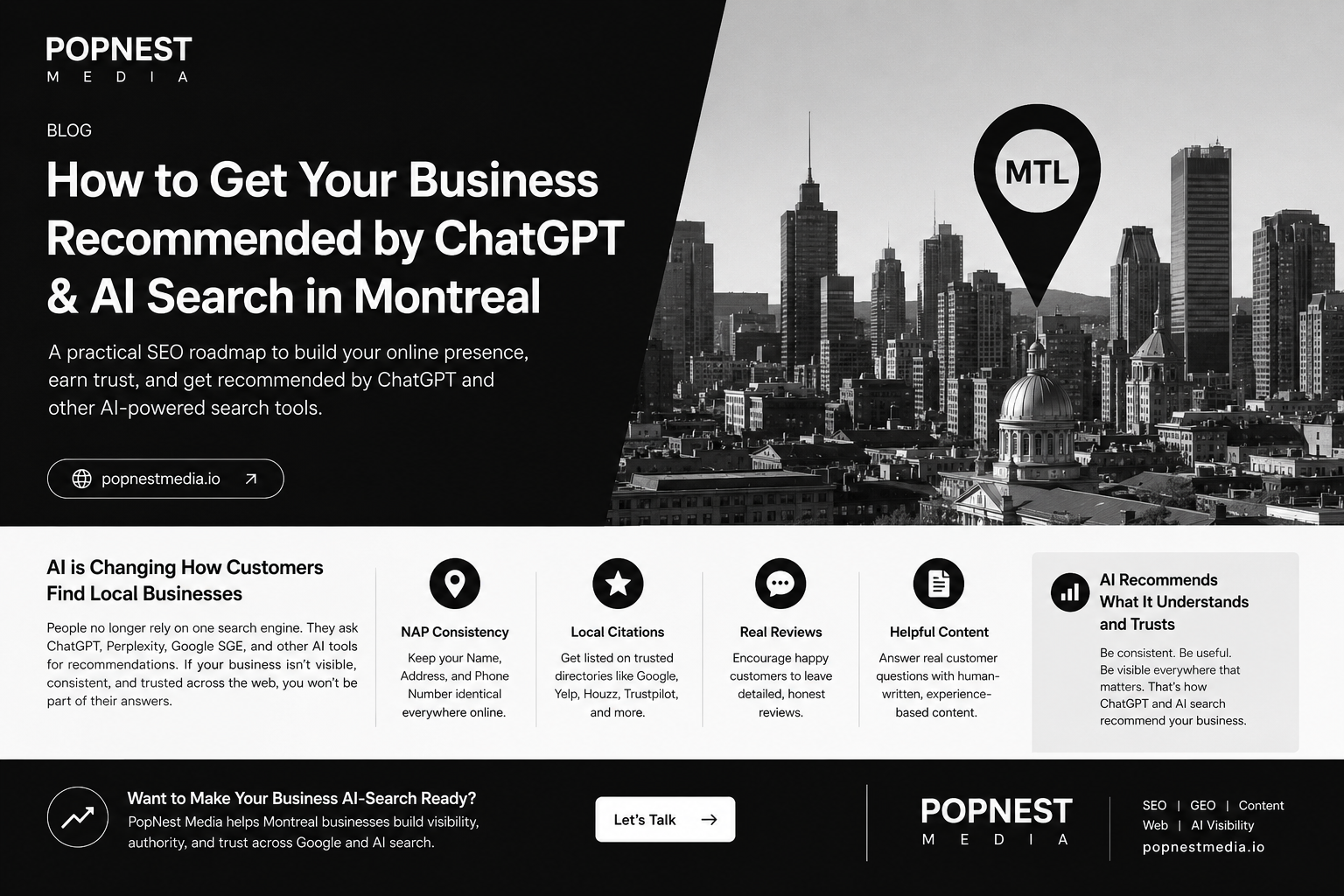
One of the first things every local business should get right is NAP consistency. NAP simply stands for Name, Address and Phone Number.
Suppose you operate a plumbing company in Montreal. Your Google Business Profile says “ABC Plumbing Montreal,” your Facebook page says “ABC Plumbing Services,” Yelp has an old telephone number and your website still shows an address you stopped using two years ago. To a person, these may look like small mistakes. To search systems trying to connect information from different sources, they create unnecessary ambiguity.
Your real business name, telephone number, physical address or service area, website, opening hours and other core information should therefore remain accurate across your website, Google Business Profile, Bing, Facebook, Instagram, LinkedIn and the directories where the company is listed.
Do not rename your business simply because you want “Montreal plumber” or another keyword inside the name. The goal is not to manufacture relevance. The goal is to make your genuine business entity consistent enough that there is little doubt about who you are, what you do and where you operate.
This is one of the foundations behind the broader local SEO and GEO strategy used by PopNest Media. Explore PopNest Media’s SEO and GEO services
What Are Local Citations, and Why Do They Matter?
A local citation is an online reference to your business. It commonly includes your business name, address, telephone number, website, category or other identifying details.
For a home-service business, those citations might appear on Google Business Profile, Bing Places, Yelp, Houzz, Trustpilot, local chambers of commerce, professional associations, industry directories and genuine local websites.
The objective is not to submit the company to 500 low-quality directories. That old-style SEO approach creates noise rather than authority. What matters is having accurate listings on websites that are relevant to your location, industry and customers.
If a plumber in Montreal has the same business information across its website, Google Business Profile, trusted home-service directories and local business resources, those references create a much cleaner digital footprint than a company whose information changes from one site to another.
Think of these citations as independent pieces of evidence. One website says the company exists. Another confirms the location. Reviews confirm that people have used the service. A local article mentions a completed project. A Facebook page shows current activity. Together, they create a much stronger picture than a self-written About page alone.
Your Website Should Answer the Question Before AI Has to Guess
If somebody asks ChatGPT:
“Who is a reliable plumber in Montreal?”
your website should give search systems enough information to understand why your business may be relevant to that question.
That means clearly explaining what services you offer, where you operate, who you help and what makes the company credible. A homepage filled with statements such as “We provide world-class solutions with unmatched quality” says very little.
A stronger website says something meaningful:
“We provide emergency plumbing, drain cleaning, water-heater repair and residential plumbing services across Montreal and Laval.”
It is not flashy, but it is clear.
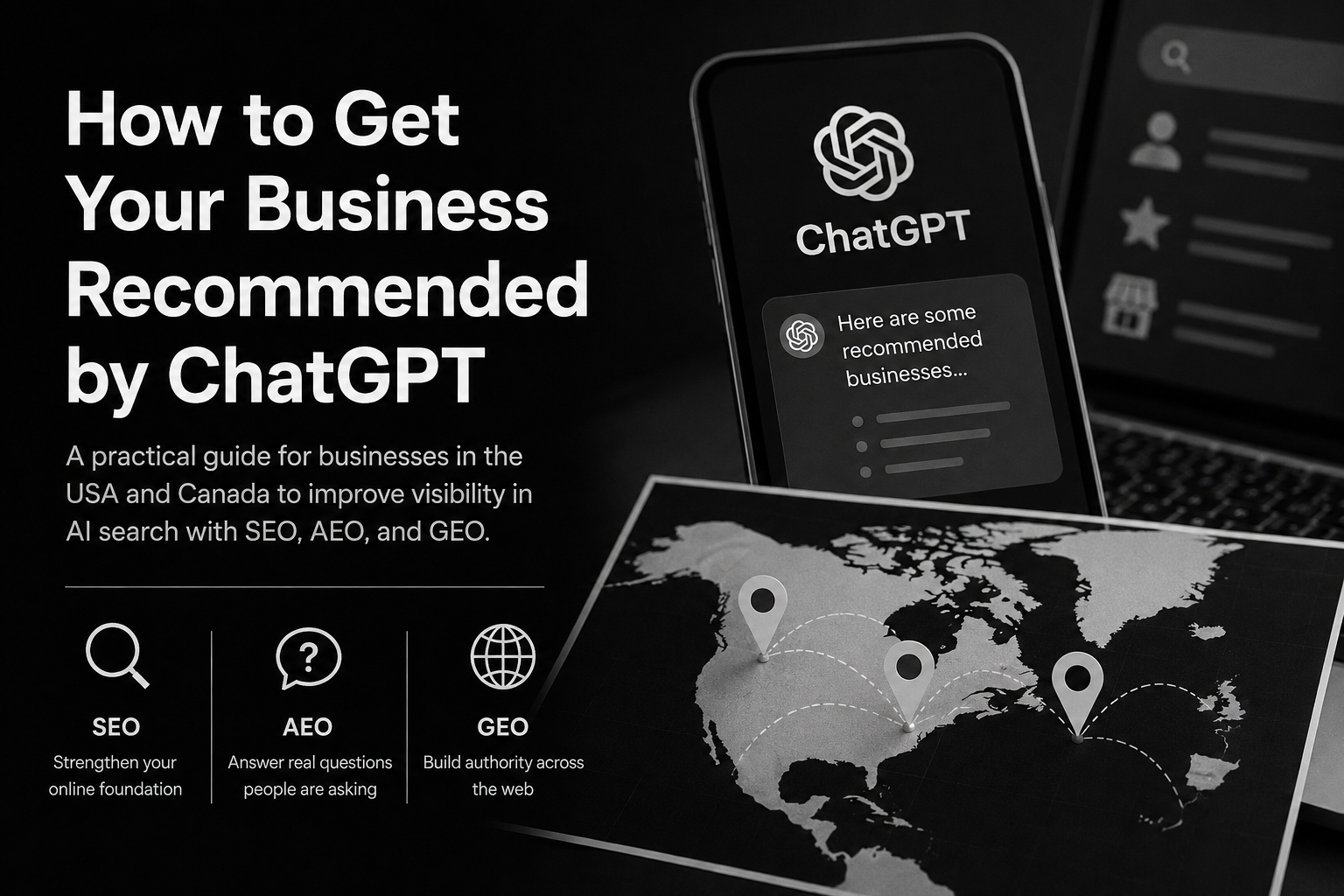
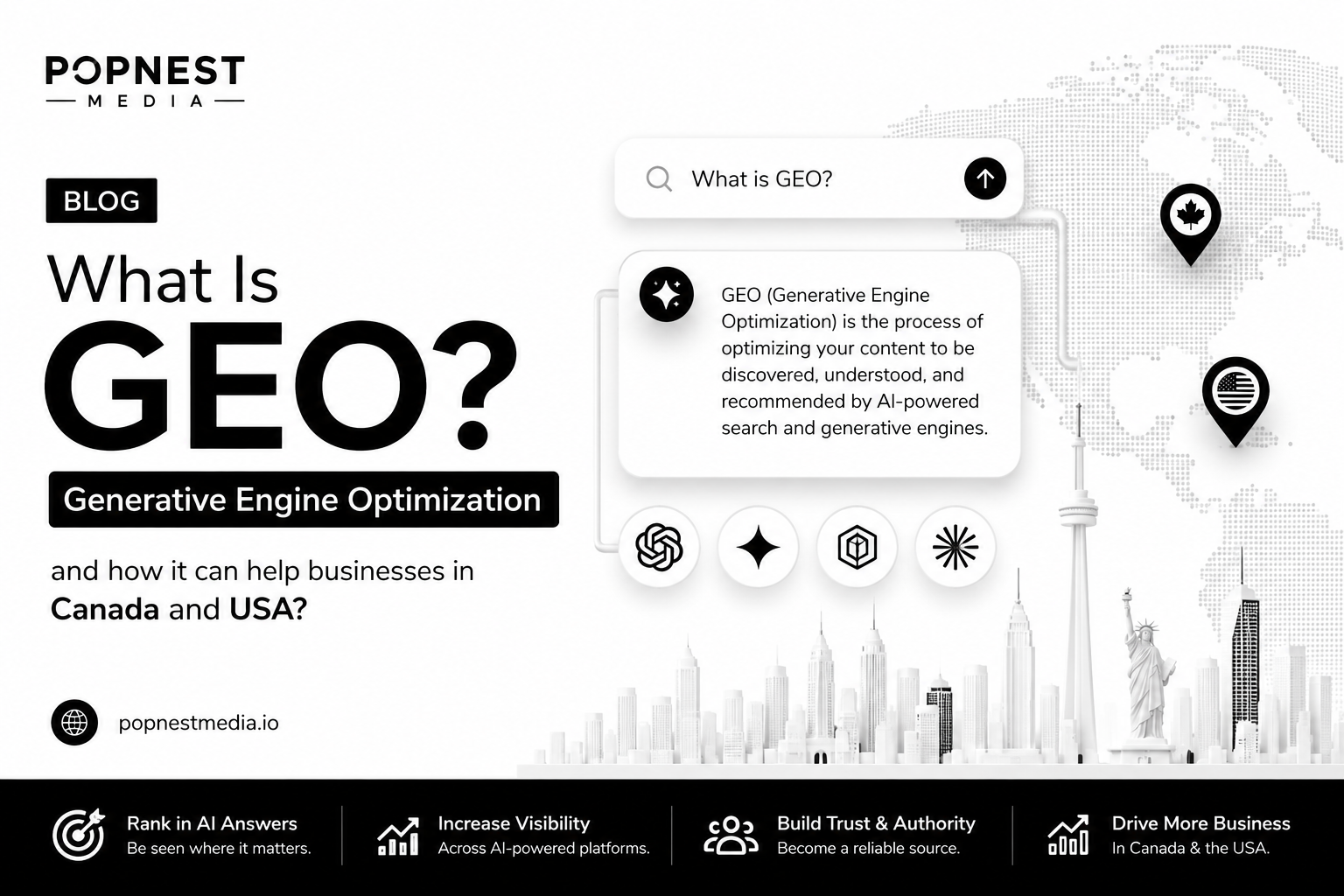
This is where traditional SEO, Answer Engine Optimization (AEO) and Generative Engine Optimization (GEO) start working together. SEO helps your pages get discovered. AEO makes the answer easy to extract. GEO strengthens the wider information and authority around the brand.
PopNest Media explains this wider relationship between SEO, AEO and GEO in its existing guide on AI-search visibility. Read PopNest Media’s guide to getting recommended by ChatGPT
Create Service and Location Content Around Real Customer Intent
A plumber should not publish fifty articles simply because an AI tool generated fifty keywords.
Start with what customers actually need.
Someone searching for “emergency plumber Montreal” has a different problem from someone researching “how much does it cost to replace a water heater?” Your website should address both types of intent.
That could mean creating strong service pages around emergency plumbing, drain cleaning, water-heater repairs and bathroom plumbing, while supporting those pages with useful articles such as “What to Do When a Pipe Bursts During a Montreal Winter” or “Repair or Replace? When a Water Heater Is No Longer Worth Fixing.”
The content becomes valuable because it solves a problem, not because it reaches an arbitrary word count.
Google’s documentation also recommends LocalBusiness structured data to help clearly describe business information such as the organization name, address, telephone number, opening hours and other details in a machine-readable format.
Structured data will not automatically put a company at number one, but clear technical information reduces ambiguity and helps search systems interpret your business correctly.
Google Business Profile Is Still a Major Part of the Equation
A local SEO strategy without a properly managed Google Business Profile is incomplete.
Your primary and secondary categories should accurately describe the company. Services, telephone number, opening hours, website, service areas and business description should stay current. Real photographs of employees, projects, vehicles, completed jobs and day-to-day operations are far more useful than filling the profile with generic stock graphics.
The same applies to posts. Instead of posting:
“Contact us today for professional plumbing solutions.”
publish something that reflects the real business:
“We were called to a property in Laval this morning after the homeowner noticed water around the base of the water heater. The problem turned out to be a failed pressure-relief component. Here is what homeowners should look for before a small leak becomes major water damage.”
That post gives location, context, experience and useful information without sounding as though it was produced from a generic AI prompt.
Reviews Are More Than Reputation Management
Reviews have always mattered for local businesses, but they become even more valuable in an environment where people increasingly use multiple sources to decide which company to trust.
A review saying:
“Great service. Highly recommended.”
is useful.
A review saying:
“We called them for an emergency pipe leak at our home in Montreal. They arrived the same afternoon, explained where the leak was coming from and repaired it without trying to sell us unnecessary work.”
contains much richer information.
It naturally connects the business with a service, location and customer experience.
This does not mean asking customers to insert keywords into their reviews. Reviews should remain genuine. It simply means that real customers naturally provide details that marketing copy cannot manufacture.
A 2025 consumer search study found that people increasingly use several channels when researching local businesses, while generative AI is becoming part of the discovery process alongside traditional search and social platforms. The same research found that basic information such as contact details and opening hours remains extremely important when consumers assess a local business.
The lesson is straightforward: AI search may be new, but customers still need reliable business information.
Human Content Matters More as AI Content Becomes Easier to Produce
Businesses are producing more content than ever because generative AI can create a blog post in seconds. That does not mean the internet needs another thousand generic articles titled “10 Benefits of Hiring a Professional Plumber.”
AI can absolutely help with research, editing, outlining and organizing information. The problem begins when AI replaces the business's actual knowledge.
The most useful content contains information that could realistically come from your employees, customers or operations: questions customers repeatedly ask, unusual problems your team encountered, photographs from actual jobs, seasonal issues in your city, mistakes homeowners make, pricing explanations, case studies and observations based on your own work.
For a Montreal plumber, “Why Pipes Freeze in Montreal Homes and What to Do Before Calling a Plumber” has significantly more potential value than another vague article about the importance of plumbing.
This approach is also more sustainable for social media. Facebook, Instagram and LinkedIn should not become dumping grounds for rewritten ChatGPT captions. Use real photos, real projects, real locations and actual observations, then use AI to improve the presentation where needed.
The principle should be simple: AI should assist the expert, not pretend to be the expert.
Social Media Should Confirm That the Business Is Real and Active
Your website is not the only place people or search systems, may encounter the company.
If your Instagram account has not been updated for two years, Facebook contains an old telephone number and LinkedIn describes services that are no longer available, you are creating conflicting information around the brand.
A healthier social presence confirms what your website already says.
If you completed a plumbing project in Montreal, talk about it. If customers repeatedly ask the same question, answer it. If winter temperatures are causing a particular issue this week, discuss it. If your technicians are working in Laval, share genuine footage or images from the work where appropriate.
That is much more valuable than posting “5 plumbing tips” because a social media calendar told you Tuesday was an educational-content day.
Reddit and Facebook Groups Can Build Real Authority—If You Actually Help People
Reddit, local Facebook groups, community forums and other discussion platforms are valuable because they contain the questions people ask when they are not speaking in polished marketing language.
Someone may not search Google for “symptoms of a partially obstructed residential drainage system.”
They will post:
“My basement drain smells horrible every time it rains. What is going on?”
That is the language businesses should pay attention to.
Use these communities for research and genuine participation. Answer questions you are qualified to answer, correct misinformation when necessary and explain the reasoning behind the solution.
Do not create fake Reddit accounts praising your company. Do not pretend to be a customer. Do not spam local groups with links.
If you are useful enough, people eventually check who you are.
Those discussions can also reveal hundreds of real questions worth answering on your website.
Build Topical Authority Instead of Publishing Random Blogs
If your company wants to become associated with plumbing, your website should demonstrate meaningful depth around plumbing.
Create clusters of related content. A water-heater service page can be supported by articles about lifespan, strange noises, temperature problems, leaking tanks, replacement costs and maintenance.
A drain-cleaning page can connect with content about sewer backups, recurring clogs, tree-root intrusion and warning signs.
This is topical authority in practical terms. Rather than publishing unrelated keywords, you are building a connected knowledge base around the services the company genuinely understands.
Internal links then help people and crawlers move logically through that information.
This same approach is part of PopNest Media's wider SEO and AI-first content strategy. Learn more about PopNest Media’s SEO approach
Technical SEO Still Matters in the Age of ChatGPT
All of the authority in the world is less useful if important pages cannot be crawled.
Your website should have clean navigation, indexable service pages, useful title tags, descriptive headings, canonical tags where appropriate, XML sitemaps, internal linking and valid structured data.
Site speed and mobile usability matter as well. A potential customer with water pouring through a ceiling does not want to wait eight seconds for an animated homepage to load.
For AI-search visibility specifically, businesses should also verify that they have not unintentionally blocked relevant crawlers.
OpenAI says that websites wanting content to be eligible for inclusion in ChatGPT Search should allow OAI-SearchBot to crawl their public content. OpenAI also notes that inclusion or high placement cannot be guaranteed.
That is a much more important technical check than blindly installing every new “AI SEO” file promoted online.
What About llms.txt?
There has been growing discussion around llms.txt, a proposed standard intended to provide AI systems with a simpler representation of important website content.
It is worth watching and can be implemented as an additional accessibility layer where appropriate.
However, businesses should be careful with claims such as:
“Install an llms.txt file and ChatGPT will start recommending your company.”
There is no basis for making that promise.
At the moment, your priorities should remain crawlability, meaningful website content, structured business information, credible external references and real authority.
llms.txt can complement that work. It should not replace it.
Brand Mentions Matter Alongside Traditional Backlinks
Backlinks are still valuable, but AI-era authority should be thought about more broadly.
Ask yourself:
Where on the internet is my company independently discussed or verified?
A backlink from a local publication after your company contributed useful data can be valuable. So can a relevant industry directory, a professional association profile, an interview, an authentic Reddit discussion or a local community feature.
A thousand unrelated backlinks bought from random websites do not create the same quality of signal.
The goal is to build a believable web presence around the brand.
In other words, do not build backlinks simply because “SEO needs backlinks.” Build references in places where it makes sense for your business to exist.
AI Search Is Increasing the Value of Reliable Sources
OpenAI describes ChatGPT Search as a system that can search the live web and provide answers with links to relevant sources.
That distinction is important.
Businesses sometimes imagine ChatGPT has a permanent internal list of “the ten best plumbers in Montreal.” That is not how businesses should think about it.
Different searches can produce different answers depending on the wording of the question, location, freshness of information and sources available at the time.
Therefore, your goal is not to get added to some imaginary permanent ChatGPT directory.
Your goal is to make your company a credible candidate whenever relevant sources are being evaluated.
How Should You Test Whether ChatGPT Can Find Your Business?
Do not test only by asking:
“Tell me about ABC Plumbing.”
That is a branded search. You have already given the system the answer.
Instead, test the types of discovery questions real customers ask:
“Recommend a reliable plumber in Montreal.”
“Who are some highly rated emergency plumbers in Montreal?”
“Which plumbers in Laval provide same-day service?”
“What is a good plumbing company for water-heater repair near me?”
Then look at the businesses being recommended and, when citations are provided, inspect the sources behind the answer.
Check whether competitors have stronger review profiles, better local citations, more useful service pages, clearer business information or more third-party references.
Testing from another person's device or account can sometimes help you compare results, particularly for local searches, but switching browsers or changing an IP address should not be treated as a scientific ranking experiment. OpenAI confirms that location information can be used to make certain searches more locally relevant.
AI recommendations can also change from one query to another, so track a consistent set of non-branded questions over time instead of drawing conclusions from a single search.
The Real Strategy Is Entity Trust
The future of local SEO is not about choosing between Google SEO and ChatGPT optimization.
A strong strategy makes the business understandable everywhere.
Your website says who you are. Your Google Business Profile confirms it. Your directories contain the same details. Customers describe real experiences in reviews. Social media demonstrates current business activity. Local websites mention your work. Your blogs answer genuine customer questions. Your technical SEO makes the information easy to crawl and interpret.
All of these signals reinforce one another.
That is why the strongest AI-search strategy is surprisingly human:
Be a real business. Solve real problems. Publish real knowledge. Keep your information accurate. Earn genuine reviews. Become visible in the places where your customers already spend time.
Then make all of that information technically accessible to search engines and AI systems.
That is where SEO, local citations, AEO and GEO meet.
For businesses that want to build this entire system rather than chase individual rankings, PopNest Media works across SEO, GEO, content, website optimization and wider digital visibility to help brands become easier to find—and easier to trust—in both traditional and AI-powered search.